Announcement

HydraDB is now open source.

Announcement

HydraDB is now open source.

HydraDB is now open source.

GraphDB built on object storage: 10x cheaper, ultra fast, and purpose-built for modern AI workloads.


Build ontologies, agent memory, company brains, and context graphs.

$6.5M Raised

Jeff Dean

Researchers from OpenAI and DeepMind

Sky9 Capital

Sky9 Capital

0123456789
0123456789
0123456789
0123456789

.

.

0123456789
0123456789
%
0123456789
0123456789
%

LongMemEval-S Overall

0123456789
0123456789
0123456789
%
0123456789
0123456789
0123456789
%

Single Session Recall

>
0123456789
0123456789
%
>
0123456789
0123456789
%

Accurate vs Full Context GPT-4

Accurate vs Full Context GPT-4

0123456789
0123456789
0123456789
0123456789
K
0123456789
0123456789
K

Avg. Token / Stack

Avg. Token / Stack

// Use Cases //

What Engineers Are
Building With HydraDB

What Engineers Are Building With HydraDB

01 AGENT MEMORY

Build in-house memory systems. With your ideas, for your AI.

02 ONTOLOGIES

03 COMPANY BRAIN

04 AGENTIC ACTIONS

05 CONTEXT ENGINEERING

Own your memory layer. No third-party abstraction. No data leaving your stack.

Graphs work better for storing user preferences, past interactions, and agent traces.

Git-style temporal versioning recalls what was true at any point in time.

Entity resolution and preference checks across sessions prevent duplicate memory records.

01 AGENT MEMORY

Build in-house memory systems. With your ideas, for your AI.

Own your memory layer. No third-party abstraction. No data leaving your stack.

Graphs work better for storing user preferences, past interactions, and agent traces.

Git-style temporal versioning recalls what was true at any point in time.

Entity resolution and preference checks across sessions prevent duplicate memory records.

02 ONTOLOGIES

03 COMPANY BRAIN

04 AGENTIC ACTIONS

05 CONTEXT ENGINEERING

01 AGENT MEMORY

Build in-house memory systems. With your ideas, for your AI.

Own your memory layer. No third-party abstraction. No data leaving your stack.

Graphs work better for storing user preferences, past interactions, and agent traces.

Git-style temporal versioning recalls what was true at any point in time.

Entity resolution and preference checks across sessions prevent duplicate memory records.

02 ONTOLOGIES

03 COMPANY BRAIN

04 AGENTIC ACTIONS

05 CONTEXT ENGINEERING

Similarity isn't Always relevance.


Similarity search often returns whats close and not whats related.

HydraDB connects your context, builds a structured graph, and delivers the exact context agents need.

Relational-first, preference-aware, temporally versioned, precision recall.

Without graphs

Retrieve similar ≠ relevant data

Missed relationships

between concepts, entities, events

Lost agent traces, interactions, user preferences across sessions

Juggling with VectorDB, GraphDB, Postgres with Temporal & filesystems across pipelines

With HydraDB

Make AI stateful with relevant context. Built to compound intelligence.

Get a complete structured view of your knowledge

Personalize results powered by what your agents have learnt from your users

One unified layer combining graphs with all primitives needed to deliver context to AI systems

Everything you need to Compound Intelligence

High Recall Accuracy

Learn how we lead on LongMemEval-S (90%+), BEAM, and FinanceBench.

0%
Accuracy

Scales with your Systems

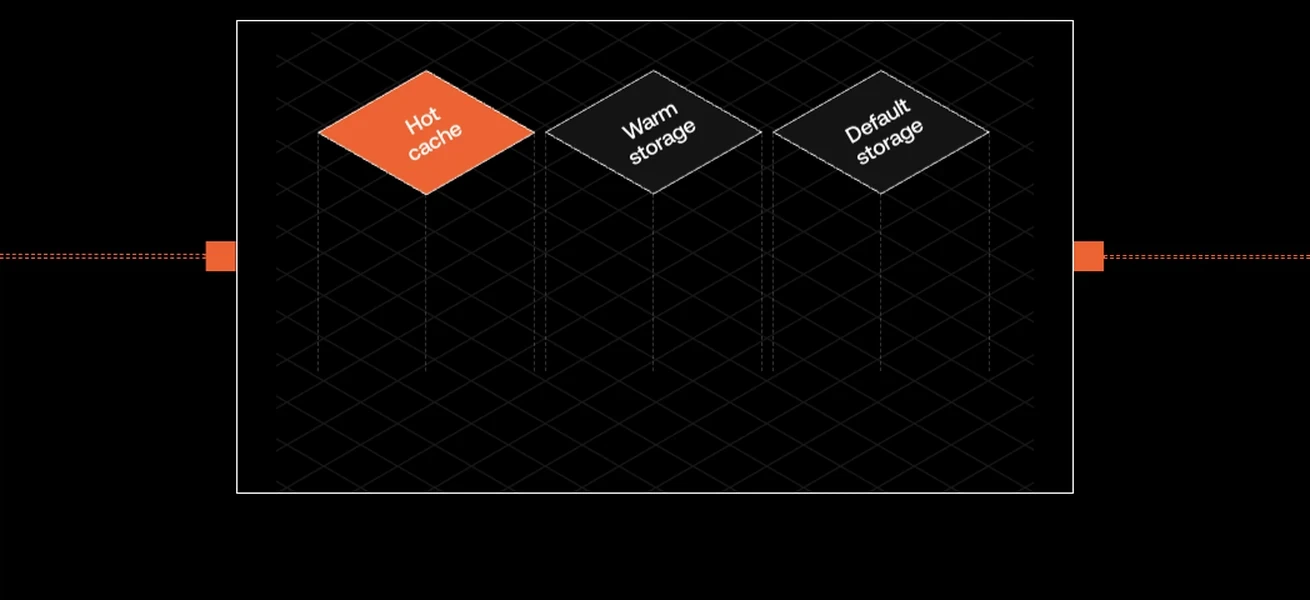
Designed for high throughput using tiered storage: a hot in-memory cache, NVMe SSD for warm storage, and object storage for cold archival. Context moves fluidly between tiers.

In memory -> SSD -> Object Storage

In memory -> SSD -> Object Storage

In memory -> SSD -> Object Storage

Recall Everything

Assemble context from business data, workplace apps, chat sessions, documents. Remember user preferences while retrieving.

Data

Chat

Preference

Built for Low

Latency Apps

Built for low-latency apps — so you can build real-time applications with HydraDB.

< 200ms

Recall degradation As a bottleneck

Embeddings hit a hard geometric ceiling as context scales

VectorDBs are stateless by design, cannot personalize results

Current systems are stitched implementations between vectorDBs, graphs, relational data stores; difficult to maintain, hard to scale

Recall degradation As a bottleneck

Embeddings hit a hard geometric ceiling as context scales

VectorDBs are stateless by design, cannot personalize results

Current systems are stitched implementations between vectorDBs, graphs, relational data stores; difficult to maintain, hard to scale

Accuracy vs Context length

ACCURACY %

100

80

60

40

20

0

HydraDB

90.79%

71%

38%

8K

32K

64K

96L

115K

CONVERSATION TOKENS

ACCURACY %

100

80

60

40

20

0

HydraDB

90.79%

71%

38%

8K

32K

64K

96L

115K

CONVERSATION TOKENS

HydraDB

VectorDB

Full Context GPT-4o

Graph native context infrastructure for agents

Purpose-Built To Deliver Precise Context & Observability Into Why Agents Act The Way They Do.

Graph native context infrastructure for agents

Purpose-Built To Deliver Precise Context & Observability Into Why Agents Act The Way They Do.

Total documents ingested

1 Billion+

Recall accuracy

92%

Retrievals per month

~1 Million

Trusted by

2k devs

Architecture Overview

ORCHESTRATION AROUND THE GRAPH DATABASE

User

Request Understanding

routing · entity extraction · query rewrite · safety flags

Retrieval Orchestrator

cypher reads / writes

Vectorstore (plugin)

semantic + bm25 + rerank

Connectors (plugin)

100+ sources: workspace, email, crm

DB Filters (plugin)

SQL / NoSQL

THE GRAPH DATABASE CORE

Extremely fast, multi tenant, and built on object storage

NAMESPACE — multi-tenant isolation, auto-scalable

Writer Node

Cypher writes → WAL + value log (S3 + disk cache)

Indexer Node

reads WAL entries → builds index (GraphBLAS)

Reader Node

Cypher queries → index + pending WAL = strongly consistent

Unified Storage

S3 · object-storage native

namespace/data/wal

namespace/data/value

namespace/index

namespace/manifest.json

Tiered · Context flows across tiers on demand

Hot

in-memory cache

Warm

NVMe SSD

Cold

object storage

Total documents ingested

1 Billion

Retrievals per month

1 Million

Recall accuracy

92%

Trusted by

2k devs

State of the art on various benchmarks

HydraDB outperforms various context applications on five of six LongMemEval-S categories. Last updated: March 2026

Gemini 3.0 primary

Gemini 3.0 primary

90.79%

90.79%

90.79%

GPT 5 Mini (Compact)

GPT 5 Mini (Compact)

85.80%

85.80%

85.80%

GPT 5.2 (Latest)

GPT 5.2 (Latest)

84.73%

84.73%

84.73%

Category

HydraDB

mem0-oSS

ZEP

Full Context

Full Context

Single Session (User)

100.00

38.71

92.90

81.40

Single Session (Assistant)

100.00

8.93

80.40

94.60

Preference Extraction

96.67

40.00

56.70

20.00

Knowledge updates

97.43

52.56

83.30

78.20

Temporal Reasoning

90.97

25.56

62.40

45.10

Multi-session reasoning

76.69

20.30

57.90

44.30

Overall Score

90.79

29.07

71.20

60.20

Pricing


Storage-based pricing with minimum commitment. No per-seat, feature, API limits, or infra caps.

Pay for how much context your agents consume.

Ship

For shipping your first team of agents

Free

Unlimited API calls & tenants

Multi-tenancy

Observability & traces dashboard

Native connectors to apps (coming soon)

Community Slack & Email Support

Surge

For agents scaling fast in production


$25/
month

Everything in free, plus:

Up to 2GB graph storage

Overage at $0.50/GB/mo

Private Slack Channel

SOC2, GDPR reports, DPA

Scale

Making your agents enterprise- ready

$399/
month

Everything in surge, plus:

Up to 10GB graph storage

Overage at $0.25/GB/mo

Dedicated infrastructure for guaranteed throughput

Option to self-host (license)

Enterprise

For teams deploying HydraDB in their own VPC

Custom

BYOC and fully self-hosted

Dedicated account manager

Support & Uptime SLAs

Pricing


Storage-based pricing with minimum commitment. No per-seat, feature, API limits, or infra caps.

Pay for how much context your agents consume.

Ship

For shipping your first team of agents

Free

Unlimited API calls & tenants

Multi-tenancy

Observability & traces dashboard

Native connectors to apps (coming soon)

Community Slack & Email Support

Surge

For agents scaling fast in production


$25/
month

Everything in free, plus:

Up to 2GB graph storage

Overage at $0.50/GB/mo

Private Slack Channel

SOC2, GDPR reports, DPA

Scale

Making your agents enterprise- ready

$399/
month

Everything in surge, plus:

Up to 10GB graph storage

Overage at $0.25/GB/mo

Dedicated infrastructure for guaranteed throughput

Option to self-host (license)

Enterprise

For teams deploying HydraDB in their own VPC

Custom

BYOC and fully self-hosted

Dedicated account manager

Support & Uptime SLAs

Pricing


Storage-based pricing with minimum commitment. No per-seat, feature, API limits, or infra caps.

Pay for how much context your agents consume.

Ship

For shipping your first team of agents

Free

Unlimited API calls & tenants

Multi-tenancy

Observability & traces dashboard

Native connectors to apps (coming soon)

Community Slack & Email Support

Surge

For agents scaling fast in production


$25/
month

Everything in free, plus:

Up to 2GB graph storage

Overage at $0.50/GB/mo

Private Slack Channel

SOC2, GDPR reports, DPA

Scale

Making your agents enterprise- ready

$399/
month

Everything in surge, plus:

Up to 10GB graph storage

Overage at $0.25/GB/mo

Dedicated infrastructure for guaranteed throughput

Option to self-host (license)

Enterprise

For teams deploying HydraDB in their own VPC

Custom

BYOC and fully self-hosted

Dedicated account manager

Support & Uptime SLAs

Pricing


Storage-based pricing with minimum commitment. No per-seat, feature, API limits, or infra caps.

Pay for how much context your agents consume.

Ship

For shipping your first team of agents

Free

Unlimited API calls & tenants

Multi-tenancy

Observability & traces dashboard

Native connectors to apps (coming soon)

Community Slack & Email Support

Surge

For agents scaling fast in production


$25/
month

Everything in free, plus:

Up to 2GB graph storage

Overage at $0.50/GB/mo

Private Slack Channel

SOC2, GDPR reports, DPA

Scale

Making your agents enterprise- ready

$399/
month

Everything in surge, plus:

Up to 10GB graph storage

Overage at $0.25/GB/mo

Dedicated infrastructure for guaranteed throughput

Option to self-host (license)

Enterprise

For teams deploying HydraDB in their own VPC

Custom

BYOC and fully self-hosted

Dedicated account manager

Support & Uptime SLAs

Pricing


Storage-based pricing with minimum commitment. No per-seat, feature, API limits, or infra caps.

Pay for how much context your agents consume.

Ship

For shipping your first team of agents

Free

Unlimited API calls & tenants

Multi-tenancy

Observability & traces dashboard

Native connectors to apps (coming soon)

Community Slack & Email Support

Surge

For agents scaling fast in production


$25/
month

Everything in free, plus:

Up to 2GB graph storage

Overage at $0.50/GB/mo

Private Slack Channel

SOC2, GDPR reports, DPA

Scale

Making your agents enterprise- ready

$399/
month

Everything in surge, plus:

Up to 10GB graph storage

Overage at $0.25/GB/mo

Dedicated infrastructure for guaranteed throughput

Option to self-host (license)

Enterprise

For teams deploying HydraDB in their own VPC

Custom

BYOC and fully self-hosted

Dedicated account manager

Support & Uptime SLAs

Frequently Asked questions

What is HydraDB? How is it different from other graph databases?

HydraDB is an object-store-native distributed graph database built in Rust, designed to serve as the context layer for AI systems. Unlike traditional graph databases, where storage is tied more closely to database servers or dedicated cluster volumes, HydraDB makes object storage itself the source of truth. This lets query nodes and indexers scale, restart, or be replaced independently without moving or replicating the graph. It also supports snapshot-consistent OpenCypher, GraphBLAS-accelerated traversal, Neo4j-compatible Bolt, and HTTP APIs.

Why use a graph database like HydraDB for AI agents?

A graph database like HydraDB gives AI agents something vector search alone cannot: relationships and state. Instead of retrieving isolated chunks that merely look similar to a query, an agent can follow explicit connections between people, projects, events, policies, documents, and past actions to understand how the current situation fits together.

When should I use HydraDB instead of a vector database?

Use a vector database when your main problem is semantic search over mostly static content: finding documents, chunks, tickets, or products that are similar to a query. Use HydraDB when your AI agent needs to understand how information connects and changes over time. If the agent needs to answer questions like who owns this project, what is blocking it, which policy applies to this customer, or what changed since the last session, similarity search alone is not enough. HydraDB lets the agent traverse entities and relationships and work with structured state instead of only retrieving nearby embeddings.

Does HydraDB work with GraphRAG?

Yes. HydraDB can be used as the graph database behind a GraphRAG system. GraphRAG is a retrieval approach rather than a specific database: it builds or uses a knowledge graph, then retrieves context by traversing relationships instead of relying only on vector similarity. Microsoft’s GraphRAG architecture is explicitly designed around a storage-agnostic knowledge model and allows custom storage and workflow implementations.

How does HydraDB improve retrieval for AI agents?

HydraDB improves retrieval by combining vector search with graph traversal, exact-match search, and temporal context. Instead of returning isolated similar chunks, it reconstructs the relationships, dependencies, and latest valid state around a query, which gives AI agents a smaller, more relevant set of evidence to reason over.

Can I use HydraDB with my existing AI stack?

Yes. HydraDB plugs into your existing AI stack through Neo4j-compatible Bolt and HTTP APIs. Keep your current models, agents, and retrieval pipeline, and add HydraDB as the graph layer for connected, stateful context.

How does HydraDB use context graphs for AI agents?

HydraDB turns fragmented agent memory into a connected context graph. This lets agents retrieve not only the relevant fact, but also how that fact relates to other entities, where it came from, and what the current state is, which gives multiple agents and workflows a consistent view of the same domain.

What AI use cases is HydraDB best suited for?

HydraDB is best for AI agents that need persistent, connected context such as support agents, coding agents, research agents, GraphRAG systems, and enterprise copilots. It is especially useful when the agent needs to remember history, follow relationships, and understand how state changes over time.

Total documents ingested

1 Billion

Retrievals per month

1 Million

Recall accuracy

92%

Trusted by

2k devs